

16 / 10 / 2026
Automated Parallel Meshing for the DrivAer Notchback

From STL to solver-ready mesh
Meshing remains a major bottleneck in computer-aided engineering (CAE), accounting for 70–80% of pre-processing effort. As simulations become more realistic, input geometry grows more detailed and may contain millions of CAD surfaces. Manual meshing can be slow, difficult to reproduce and prone to geometric errors that require clean-up. The goal is to reduce mesh-generation effort for high-fidelity cases without compromising quality.
Meshing the DrivAer Notchback
ChopMesh was used in the computational fluid dynamics (CFD) workflow for the DrivAer Notchback at the AutoCFD5 prediction workshop. A supplied, decimated STL containing open and duplicate panels was imported directly, and an automated hex-dominant octree mesh was generated without manual geometry repair.
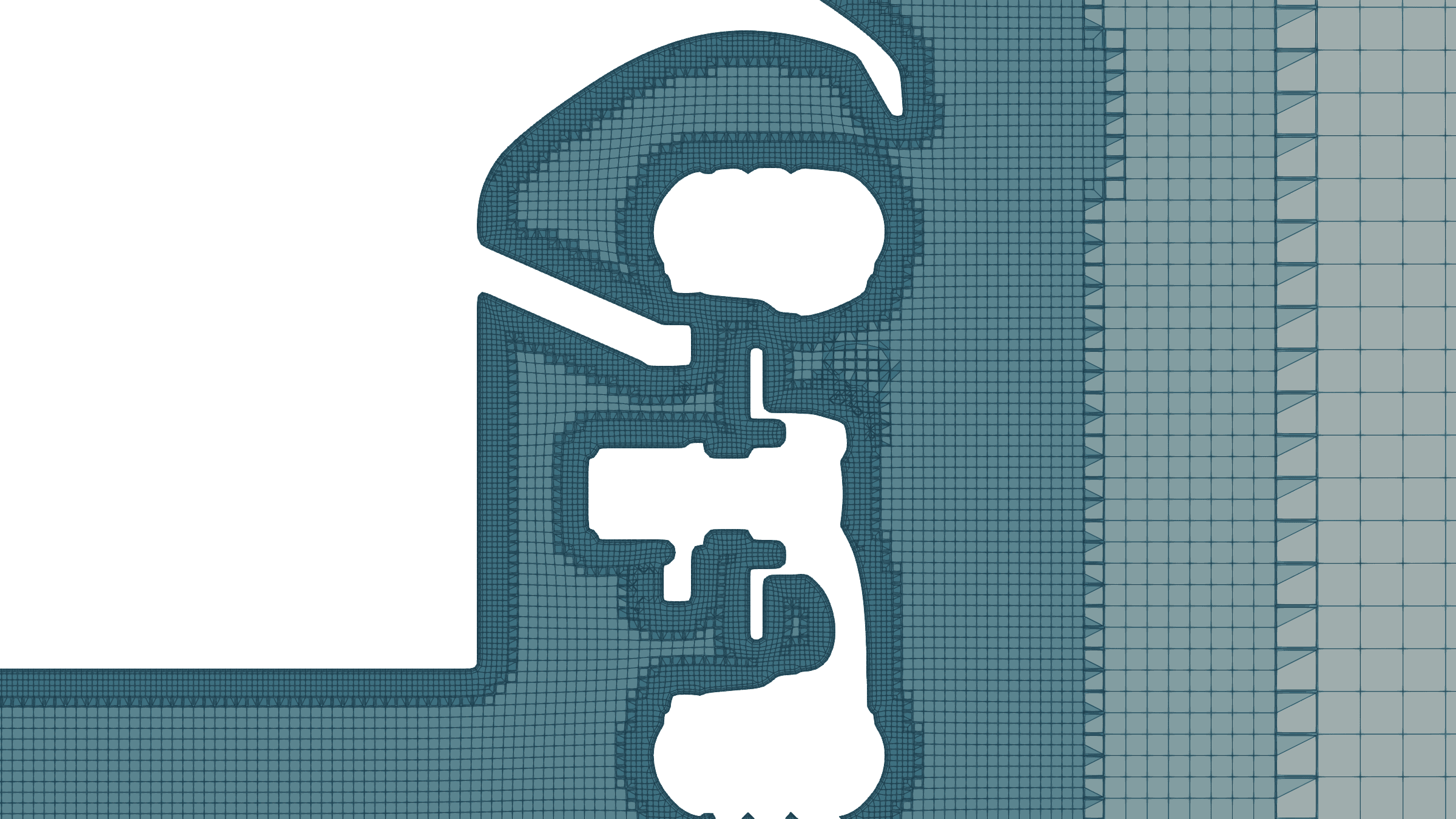
The computational domain was divided into blocks and meshed in parallel. Cubes were refined towards the surface and cut at the wall, producing approximately 64% hexahedral cells with a 2:1 transition between refinement levels. Four prism inflation layers were grown from the cut-cell wall, starting at 0.73 mm and increasing in thickness by a factor of 1.4.


Refinement and boundary layers
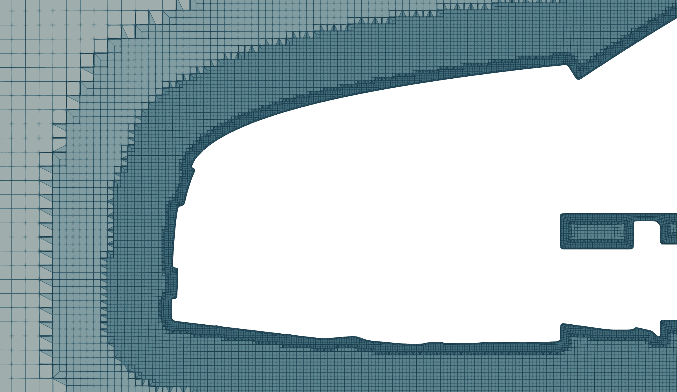
A 0.67 m background grid was refined by successive halving through nested boxes. The near-wake region used 10.4 mm cells, while two outer boxes used 20.8 mm and 41.7 mm cells to extend wake resolution downstream.
The car surface used 5.2 mm cells. At the wall, the four prism layers increased from 0.73 mm to approximately 2.0 mm. The mesh was examined around the centre-line front end, front axle and wake, including a plane 0.5 m behind the car.

Mesh quality and OpenFOAM integration

The final mesh contained 32.2 million cells, generated from a 180-cell base grid with octree refinement level 7, and was exported directly to OpenFOAM. The checkMesh assessment returned zero negative cells, a reported maximum angle of 69.8° and maximum skewness of 3.99.
Both steady RANS and unsteady URANS simulations used the k–ω SST turbulence model with the Spalding wall function.
Simulation results
The RANS case produced a drag coefficient of 0.293 and a lift coefficient of 0.040. The URANS case produced lower drag, at 0.269, and higher lift, at 0.060.
Front- and rear-axle lift coefficients were −0.049 and 0.089 respectively for RANS, compared with −0.071 and 0.112 for URANS. These axle-resolved values are reported as supplied.
The supplied analysis reports agreement between the ChopMesh RANS and URANS results and the AutoCFD5 reference case across drag, total lift, front lift and rear lift. Lift forces were higher than those obtained using the AutoCFD coarse mesh.

How the forces build along the car
Cumulative drag curves for RANS and URANS agreed over the first 0.5 m of the car. The RANS case finished 24 drag counts above URANS. The AutoCFD coarse-mesh result ran around 20 counts lower to approximately 3 m, then gained about 25 counts over the rear window and boot.

The URANS cumulative lift finished 20 counts above RANS. It showed more downforce at the front wheels, more lift over the windscreen and roof, and less downforce at the tail. The AutoCFD coarse-mesh analysis indicated additional downforce over the front wheels and bonnet, with further differences near the tail, resulting in negative total lift.

Surface pressure and vortex structures
RANS and URANS produced similar surface-pressure patterns, with stagnation at the bumper and base of the windscreen, and suction around the A-pillars, mirrors and roof edges.

Q-criterion iso-surfaces at 5,000 s⁻² captured the A-pillar, mirror and front-wheel wakes. RANS showed a larger front-wheel wake. At the rear, the same threshold revealed rear-pillar, boot and rear-wheel structures. RANS showed more vortices along the sides of the boot, while URANS showed lower velocities in the structures described in the supplied analysis.


Streamlines around the body
Streamlines were seeded 3 cm from the nose, bumper, tyre fronts, A-pillars and side windows, and traced in both directions. Paths around the body were very similar in RANS and URANS, although RANS showed slower flow near the ground at the front wheel.

At the rear, flow descended from the roof onto the boot while underbody flow moved upwards. Side flow turned in behind the rear wheels, and low-speed flow filled the wake. RANS showed slower near-ground streamlines and a wider wake spread.

Close-ups at the front wheel showed flow wrapping around the tyre and slowing inside the wheel arch. In RANS, slower streamlines escaped through the lower front region of the wheel. Around the mirror and A-pillar, flow accelerated over the pillar and around the mirror, leaving a slower wake behind the mirror head. This pattern was similar in both simulations.

A connected CFD workflow
This case demonstrates ChopMesh’s integration into a CFD workflow: import an STL, generate a 32.2-million-cell hex-dominant mesh with four inflation layers, and export directly to OpenFOAM for RANS and URANS analysis. No manual geometry repair was required before meshing.
All resources


